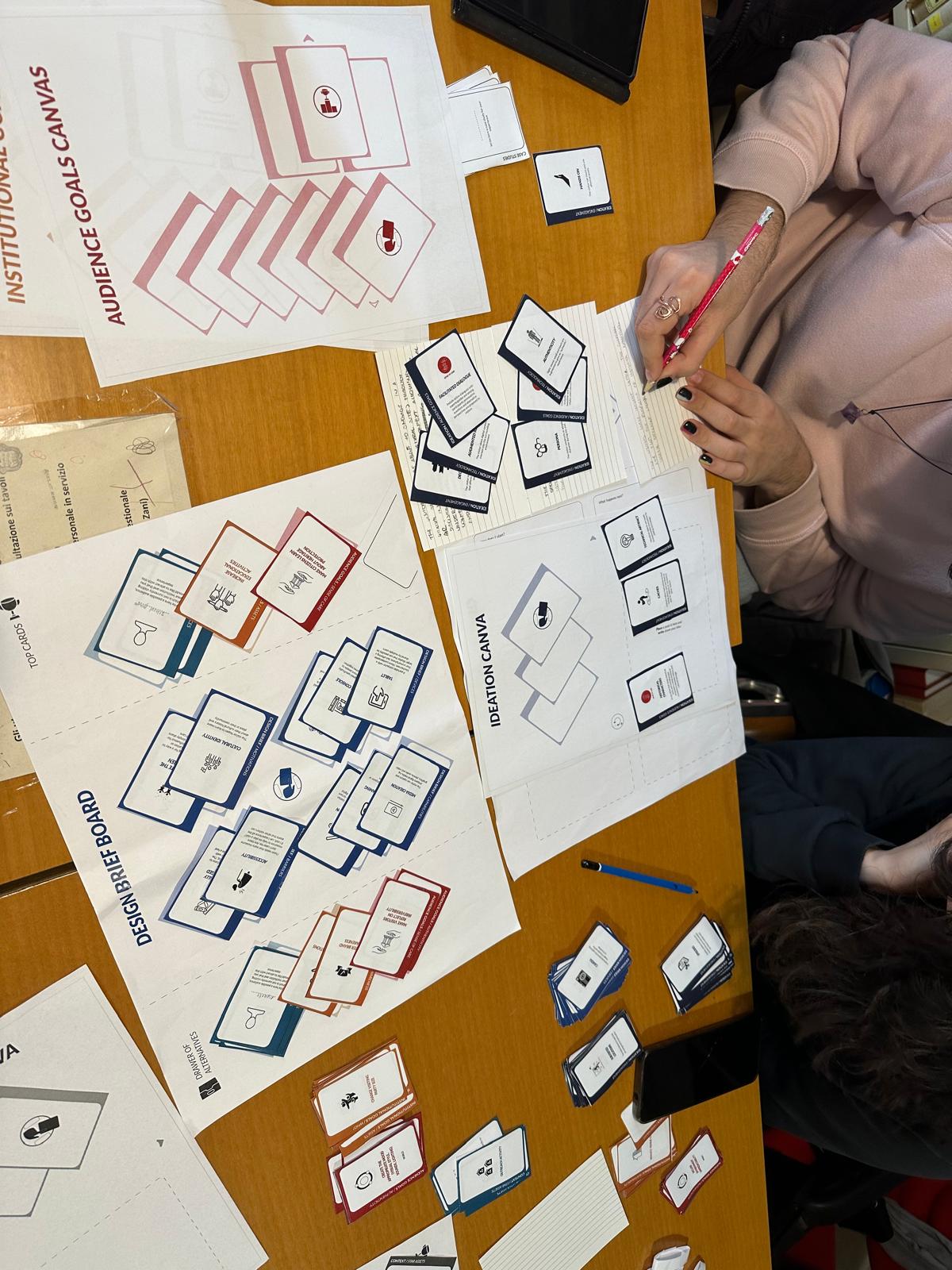
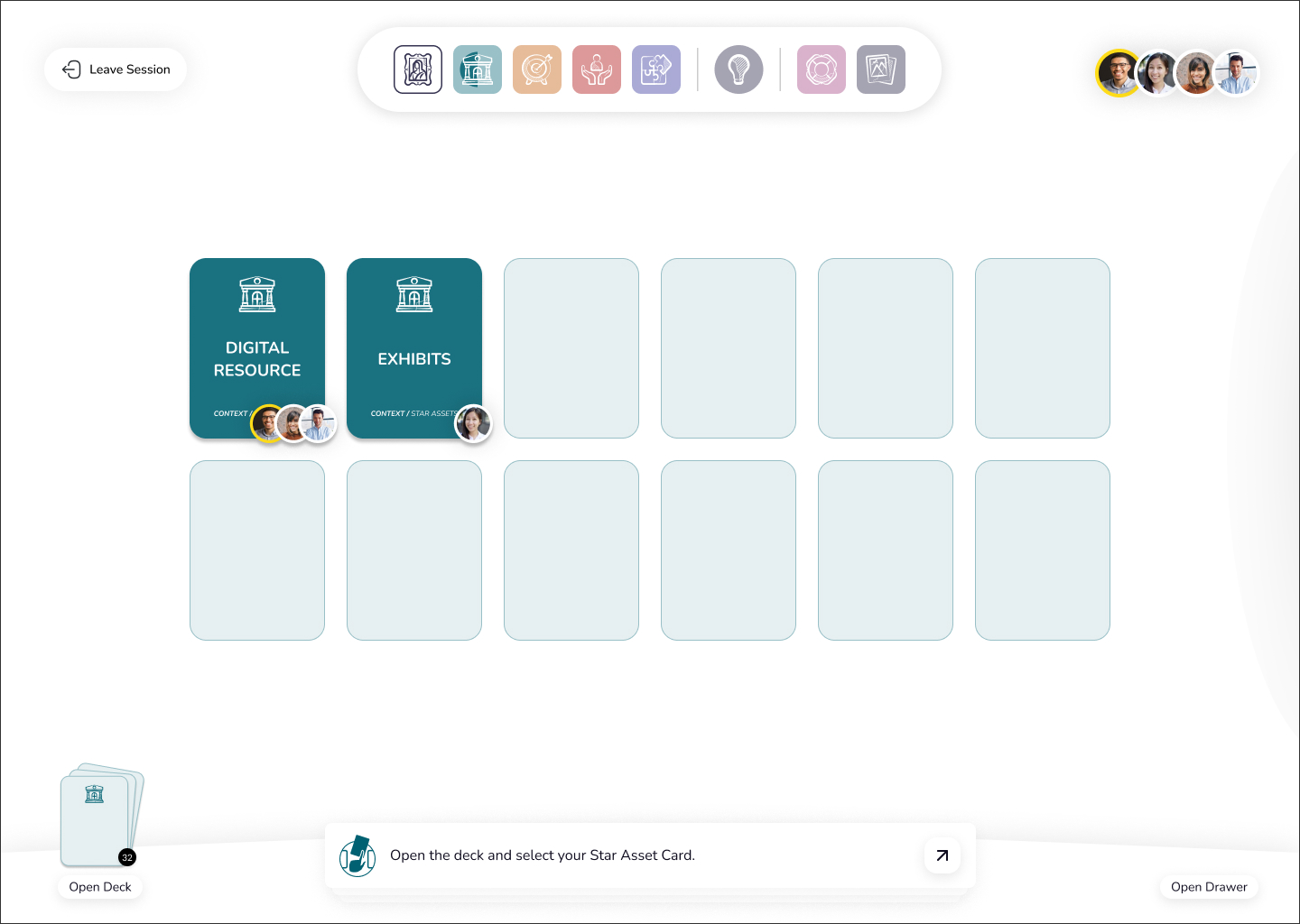
The CoDesign Tool is a card-based framework that makes collaborative design intuitive, empowering everyone to co-create engaging experiences regardless of their design background.
The CoDesign Tool guides interdisciplinary teams through the full design arc, from identifying context and goals to ideating, storyboarding, and stress-testing their concept. Each stage has its own card deck.
Explore the tool
The CoDesign Tool works in two formats. Pick the one that fits your context, then follow three simple steps.
Paper kit for in-person workshops, web app for remote or hybrid collaboration. Same method, different setup.
Two to six participants from different disciplines. No prior design experience needed.
Follow the boards stage by stage. The instruction panel guides your team through each step.
Curious about where it all started? Head to our Documentation page to discover how the tool evolved from VisitorBox, see photo highlights from our previous testing rounds, and explore our published research to learn more about it.
Read the full storyPublications
Whether you have a question about the tool, want to share how your session went, or have ideas for a new extension, write to us.
By accessing and using this website (codesign-tool-website.pages.dev / official domain), you agree to comply with and be bound by these Terms of Use. If you do not agree to these terms, please do not use the website or download any associated materials.
This website is maintained by CNR ISPC as part of the Horizon Europe PERCEIVE project (Grant Agreement No. 101061157). It serves as an open-access repository and information platform for the CoDesign Tool, a card-based framework designed for interactive and collaborative co-design in cultural heritage.
Framework materials: Unless otherwise specified, all downloadable materials related to the CoDesign Tool (including boards, canvases, card decks, and instruction panels) are licensed under a Creative Commons Attribution 4.0 International License (CC BY 4.0).
Your rights: You are free to share, copy, redistribute, adapt, and build upon the material for any purpose (including commercial use), provided you give appropriate attribution to the authors and project.
Attribution: When referencing or reusing the tool, please cite the framework as follows:
Travaglini, L., Massidda, M., Zapf, A., Spotti, S., Veggi, M., Pescarin, S. (2025). The CoDesign Tool: A Card-Based Framework for Interactive and Collaborative Design in Cultural Heritage. HCI International 2025, Springer LNCS.
When using this website and its contact form, you agree not to:
The contents and tools provided on this website are offered for informational, academic, and practical design purposes on an "as is" basis without warranties of any kind.
CNR ISPC, Fraunhofer IGD, and the PERCEIVE Consortium shall not be held liable for any direct or indirect damages resulting from the use, inability to use, or interpretation of the CoDesign Tool or materials published on this platform.
This website may contain links to third-party websites (e.g., project partners, academic publishers, external resources). We do not control or endorse the content of these external sites and accept no responsibility for them.
The CoDesign Tool was developed within the Horizon Europe PERCEIVE project funded by the European Union. Views expressed on this site do not necessarily reflect the official views of the European Union or the European Research Executive Agency (REA).
These Terms of Use are governed by Italian law. Any legal disputes shall be subject to the exclusive jurisdiction of the competent courts in Italy.
CNR ISPC – Istituto di Scienze del Patrimonio Culturale, Consiglio Nazionale delle Ricerche
Via Salaria km 29,300, 00015 Monterotondo Scalo (RM), Italy
For any questions regarding these terms, please contact: laura.travaglini@cnr.it
This website is operated by CNR ISPC (Istituto di Scienze del Patrimonio Culturale, Consiglio Nazionale delle Ricerche) in the context of the Horizon Europe PERCEIVE project (Grant Agreement No. 101061157), in collaboration with Fraunhofer IGD (Institut für Graphische Datenverarbeitung, Darmstadt, Germany).
1. Contact form submissions
When you use the contact form on this website, we collect the information you provide in order to manage and respond to your request (e.g., general support, sharing your experience/feedback, or proposing extensions to the tool).
2. Website hosting & technical log data
This website is currently hosted on Cloudflare Pages. When you visit the site, Cloudflare automatically processes basic technical data necessary for delivery, performance, and security (such as IP addresses, HTTP request headers, and system security logs).
We do not sell, rent, or commercialise your personal data.
Personal data collected through enquiries is retained only for as long as necessary to fulfill the purpose of the enquiry and subsequent follow-ups, in compliance with CNR ISPC data retention policies and EU funding project auditing requirements.
You have the right to request access to (Art. 15), rectification of (Art. 16), or erasure of your personal data (Art. 17), as well as restriction of processing (Art. 18) and the right to object (Art. 21).
To exercise your rights, please email codesigntool@cnr.it. You also have the right to lodge a complaint with a supervisory authority (in Italy: Garante per la protezione dei dati personali).
What are cookies?
Cookies are small text files placed on your device when visiting a website. They serve various functions, including enabling site security, basic navigation, and storing user preferences.
Cookies on this website
This website does not use any marketing, profiling, or behavioral analytics cookies (such as Google Analytics or Meta Pixel).
We only utilize strictly necessary technical cookies provided by our hosting platform (Cloudflare Pages) to protect the website against security threats, malicious bots, and distributed denial-of-service (DDoS) attacks. Under Italian and EU privacy laws (implementing the ePrivacy Directive), strictly necessary technical cookies do not require prior user consent.
Technical cookies used
Managing cookies
You can clear or block cookies at any time through your browser settings. However, disabling technical security cookies may prevent security challenges from completing correctly. Instructions for common browsers: